
How can cities move beyond recovering from disruption to learning from it and becoming stronger? This is the question at the center of AntifragiCity, where we are exploring how to make urban mobility systems antifragile: not just capable of resisting disruption, but able to learn from it, adapt, and improve over time.
From extreme weather to traffic congestion and other unexpected events, disruptions can affect how we move in cities. To address these challenges, we need to understand where mobility systems are most vulnerable, how they respond under pressure, and what can help them adapt when things don’t go as planned.
That is what we are working towards at AntifragiCity. Across our four demonstration cities, Bratislava, Larissa, Thessaloniki, and Odesa, we are developing models, frameworks, and decision-support tools to better understand urban mobility challenges and explore more effective ways to respond to them.
Yacine Rezgui, our Project Coordinator, shared our key results and developments so far. Take a look at what we have been working on!
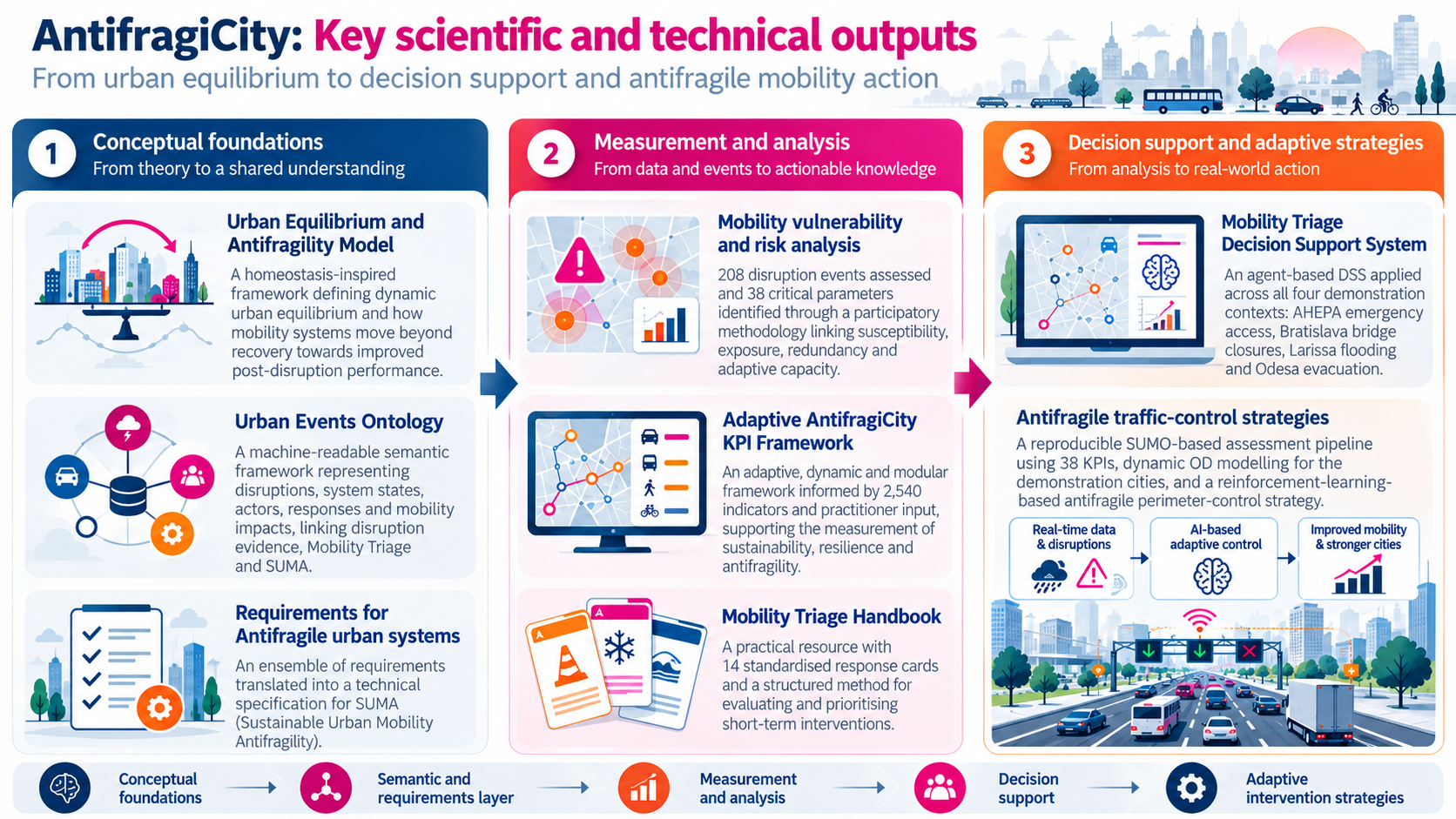
Eight key results shaping AntifragiCity
1. Understanding urban equilibrium and antifragility
Our urban equilibrium and antifragility model introduces a homeostasis-inspired framework that defines a dynamic urban equilibrium and how mobility systems can move beyond recovery towards improved post-disruption performance. *Homeostasis refers to the process by which living organisms maintain a stable internal environment despite changes around them.
2. Creating a common language for urban disruptions
Our urban events ontology provides a machine-readable semantic framework for representing urban disruptions, system states, actors, responses, and mobility impacts consistently, and creates a semantic bridge between disruption evidence, Mobility Triage, and our planned Simulator for Urban Mobility Antifragility (SUMA).
3. Defining the requirements for antifragile urban systems
To guide the development of SUMA (Simulator for Urban Mobility Antifragility), we are compiling a set of requirements that we are translating into a technical specification.
4. Developing an adaptive KPI framework
An adaptive, dynamic, and modular framework, developed from a review of 2,540 indicators and practitioner input, to measure sustainability, resilience, and antifragility.
5. Identifying mobility vulnerabilities and risks
We assessed 208 disruption events and identified 38 critical parameters, supported by a participatory methodology linking susceptibility, exposure, redundancy and adaptive capacity. These results provide the analytical basis for short-term mobility crisis response.
6. Comparing responses through the Mobility Triage Decision Support System
The Mobility Triage Decision Support System (DSS) is an agent-based decision-support tool designed to help compare and prioritise alternative responses to short-term mobility crises. It has been tested across all four demonstration contexts: AHEPA emergency access, Bratislava bridge closures, Larissa flooding and Odesa evacuation.
7. Making practical guidance available through a Mobility Triage Handbook
Alongside the DSS, our Mobility Triage Handbook translates our work into a practical decision-support resource. It includes 14 standardised response cards and a structured methodology for evaluating and prioritising short-term interventions.
8. Advancing antifragile traffic-control strategies
A reproducible SUMO-based assessment pipeline using 38 key performance indicators (KPIs), dynamic origin–destination modeling for the demonstration cities, and a reinforced-learning-based antifragile perimeter-control strategy designed to reduce disruption impacts and support learning from stress.
These developments bring us closer to our goal: helping cities build urban mobility systems that don’t just resist disruption, but learn from it and become stronger.